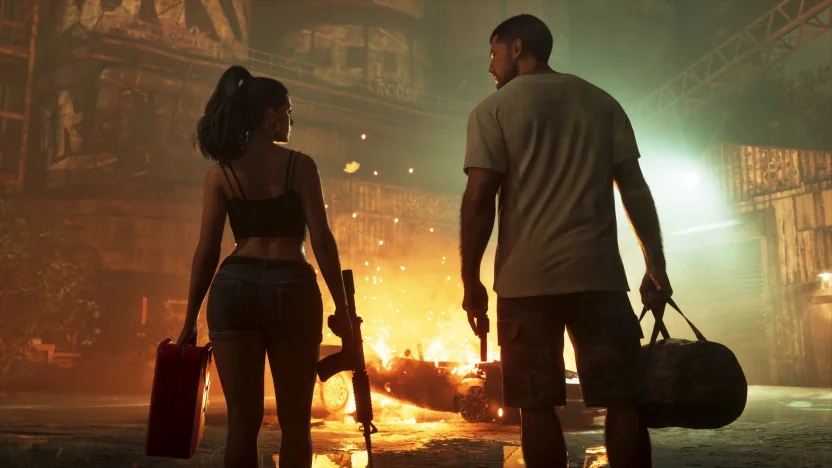
A late-October Edge preview, published by GamesRadar, suggests that Grand Theft Auto VI’s most consequential change is not simply a larger map. It is a world designed to make ordinary actions—staring at a stranger, stealing a car, changing clothes after a robbery, or entering an unfamiliar house—produce more specific consequences. The preview described a 90-minute demonstration of a current build at Rockstar North, played by co-studio head and head of development Rob Nelson. 1
The timing matters. This is a historical preview report, not a new release announcement. Rockstar still lists November 19, 2026 for GTA VI, and its current official material identifies PlayStation 5 and Xbox Series X|S as the launch platforms. Take-Two’s August 2026 investor release lists the same date and platforms; it does not list a PC version in that announced lineup. 2 3 4
The preview’s real headline: systems that connect
The reported demonstrations point to a more joined-up kind of open world. The preview describes pedestrians with personality traits that influence whether they ignore, challenge, or escalate a player’s behavior. It also reports roughly 600,000 NPC animations and reactions shaped by factors such as temperament, aggression, location, what a character has witnessed, and how the player has behaved. 1
That does not mean every passerby will become a fully scripted character. It means the old pattern—point a weapon, trigger panic, attract police—may be supplemented by more varied intermediate states. An NPC might confront Jason, run, intervene, or respond differently depending on what is visible and what has already happened. An independent recap of the same Edge feature also highlighted weapons being carried in different ways, the possibility of de-escalating some encounters, and pedestrians reacting to the state of their surroundings. 5
The practical consequence for players is uncertainty. A familiar route will not necessarily produce a familiar result, and a small interaction may be memorable because it emerges from several systems colliding rather than from a standalone mission marker. That is a reported design direction, not a guarantee that every example will occur exactly as previewed.
More interiors could matter more than more acreage
The preview reports that Leonida is roughly twice the size of Grand Theft Auto V’s map and that its total landmass is nearly comparable to the playable areas of GTA IV, GTA V, and Red Dead Redemption 2 combined. Those comparisons come through the preview’s account of Rockstar’s presentation, so they should be read as reported figures rather than an independently measured map audit. 1
The more useful detail is density. Rockstar told the publication that GTA VI contains an order of magnitude more interiors than its predecessors. Houses and other spaces are described as carrying evidence of their occupants instead of functioning only as empty shells. The preview’s examples included environmental reactions to a badly damaged interior, showing how a response originally built for a specific scenario could become a broader environmental system. 1
For players, that changes the value of exploration. A longer detour is not automatically better; the question is whether the detour offers a different social, visual, or mechanical situation. More interiors, narrower roads, longer day-night periods, and working bus and train networks could make Leonida feel less like a backdrop between missions and more like a place that keeps operating around them. The transport and day-night details were also summarized independently from the Edge issue. 5
Police escapes are about removing evidence, not just losing stars
The reported “heat” system is another example of connected systems. Instead of treating a police chase as a binary wanted-level problem, the preview describes police knowledge of details such as a suspect’s appearance, clothing, weapon, accomplice, and possible camera or witness evidence. Changing clothes, dropping a weapon, splitting from a partner, or abandoning a vehicle could therefore reduce the information tying the player to the crime. 1 5
That is still a preview claim, not a complete player-facing ruleset. Rockstar has not published a full technical explanation of every heat variable. The safe takeaway is that evasion is being presented as a process of becoming less identifiable, rather than simply hiding until a meter disappears.
Vehicle theft is reportedly subject to the same friction. Some drivers may resist, some vehicles may carry trackers, and an owner may report a stolen car. The preview and independent recap also mention a WAINK app for locating vehicles wanted by criminal fences, with the vehicle’s condition affecting the eventual payout. 1 5 These details suggest that a stolen car is not just a free change of transportation; it can be a temporary liability, a job objective, or both.
What is confirmed—and what is still only preview information?
Confirmed by current official materials: GTA VI is scheduled for November 19, 2026, on PlayStation 5 and Xbox Series X|S; Rockstar’s pre-order notice describes a single-player game and an Ultimate Edition. 2 3
Reported from the Edge/GamesRadar demonstration: the NPC animation count, personality-driven reactions, expanded interiors, heat details, police dogs, usable public transport, vehicle trackers, WAINK, and the other system-level examples above. 1 5
Not confirmed here: a PC release date or the claim that every previewed interaction will behave identically in the shipped game. This article does not present a regional retail price without a storefront check.
The most useful expectation, then, is not that GTA VI will make every minute spectacular. It is that Leonida may make more of those minutes consequential. If the reported systems survive into the final release, the biggest upgrade will be the space between missions: the moments when the world notices what the player did and reacts in a way that is harder to predict.