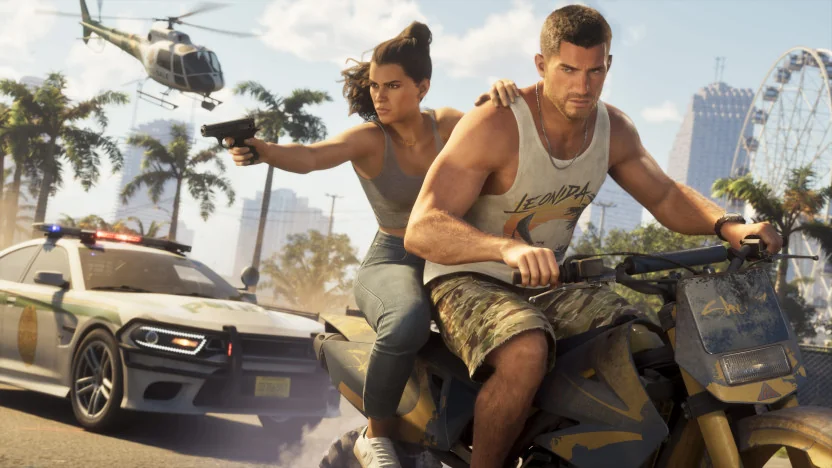
The short answer is yes: Grand Theft Auto VI is being designed to give players more room to improvise inside story missions. But the change is more specific than “every mission is a sandbox.” Rockstar North president Rob Nelson described a push to preserve authored cinematic moments while allowing systems such as police pursuits and robberies to behave more like they do in the open world. 1
That distinction matters. The October 8 news peg was not a new trailer announcing branching campaigns or a fully non-linear story. It was a developer explanation of how Rockstar is trying to reduce the friction between a mission's objective and the wider game world.
What Rockstar's mission approach actually promises
In the interview, Nelson pointed to two examples from footage shown to press. A mission set in a tower block offers multiple ways out. In another sequence involving Raul and a police chase, the game presents an optimal driving route, but taking a different route does not automatically fail the mission. The chase can continue as a systemic pursuit rather than snapping back to a single prescribed path. 1
Nelson also said the team is trying to make robberies and wanted-level sequences feel consistent with the open world. That suggests a practical kind of flexibility: the player may be able to react to changing traffic, police pressure, entrances, exits, and partner positioning instead of treating every action outside the intended line as an error.
This is a developer-stated design goal reported in an independent interview—not a published Rockstar feature list guaranteeing that every objective has multiple solutions. No official material reviewed for this article confirms that all story missions will branch, that every escape route will remain available, or that player choices will produce a different ending. Those claims would go beyond the evidence.
The important change is systemic, not simply more choices
The useful comparison is not linear missions versus infinite freedom. It is authored missions versus authored missions that can hand control back to the same systems used during free roam.
A traditional mission may require the player to follow a route, trigger a precise scene, and reach a checkpoint in a narrow order. A more systemic mission can still have a beginning, a dramatic beat, and a required outcome while allowing the middle to become messy. A police blockade might force a detour. A partner might drive while the player handles the pursuing cars. A back door, a change of clothes, or splitting up could become a response to the situation rather than a button prompt selected from a menu.
That approach could make failure feel more understandable. If a player ignores the recommended route but remains in the chase, the game is acknowledging the player's decision instead of treating deviation as disobedience. The mission remains directed, but the path through it becomes more personal.
There is a trade-off. Nelson also acknowledged that too much choice can make it harder to maintain the quality and timing of a carefully staged sequence. Rockstar's stated target is therefore a balance: cinematic beats when the narrative needs them, and open-ended systems where improvisation can add tension rather than dilute the scene. 1
What players should expect at launch
Players should approach the feature as more forgiving and reactive mission design, not as a promise of a completely emergent campaign. Some missions may offer alternate routes or approaches. Police chases and robberies may reuse open-world systems instead of behaving like isolated set pieces. Ignoring an optional route will not always end the mission immediately. Major narrative beats can still require a curated sequence.
The full range of mission outcomes remains unknown until Rockstar documents more of the game or players test it after release.
That matters for guides. Early walkthroughs should separate mandatory objectives from recommended routes. A route marker may be the safest or fastest option, not necessarily the only valid one. Conversely, a mission that tolerates a detour may still require a specific event later, so freedom should not be read as permission to skip every setup step.
Release, platforms, and price check
Rockstar's official GTA VI site still lists November 19, 2026. Take-Two's pre-order announcement lists PlayStation 5 and Xbox Series X|S as the launch platforms, with an announced U.S. standard price of $79.99 and an Ultimate Edition at $99.99. Prices and availability can vary by territory, retailer, taxes, and later updates. 2 3
The same announcement does not list a PC launch version, so this article makes no PC-release assumption.
GTA VI appears to be loosening the boundaries around story missions without abandoning Rockstar's cinematic structure. The supported part is the developer's stated effort to open missions where possible, especially when a sequence can use wanted, robbery, and open-world systems naturally. How often that freedom appears and how far it affects story outcomes remain open questions.
For players, follow the objective, but do not assume the highlighted route is the only route. Try the side street or alternate exit—while remembering that Rockstar is still building a directed story, not a campaign with no authored rails at all.